Character motivation is the reason a character does what they do in a story. Herman Melville's Moby-Dick is a long lesson in it, because nearly everyone on the ship wants something different from the same voyage, and Melville lets them say so out loud.
The scene we would start with is chapter 36, "The Quarter-Deck." Captain Ahab calls the whole crew together and nails a gold coin to the mainmast. Whoever first sights a white whale "with a wrinkled brow and a crooked jaw" gets the coin. The men cheer. Then Starbuck, the first mate, says what he signed up for: "I came here to hunt whales, not my commander's vengeance." He even asks how many barrels of oil the revenge will bring in. Ahab hits his own chest and says his vengeance "will fetch a great premium here!"
A want you could point at
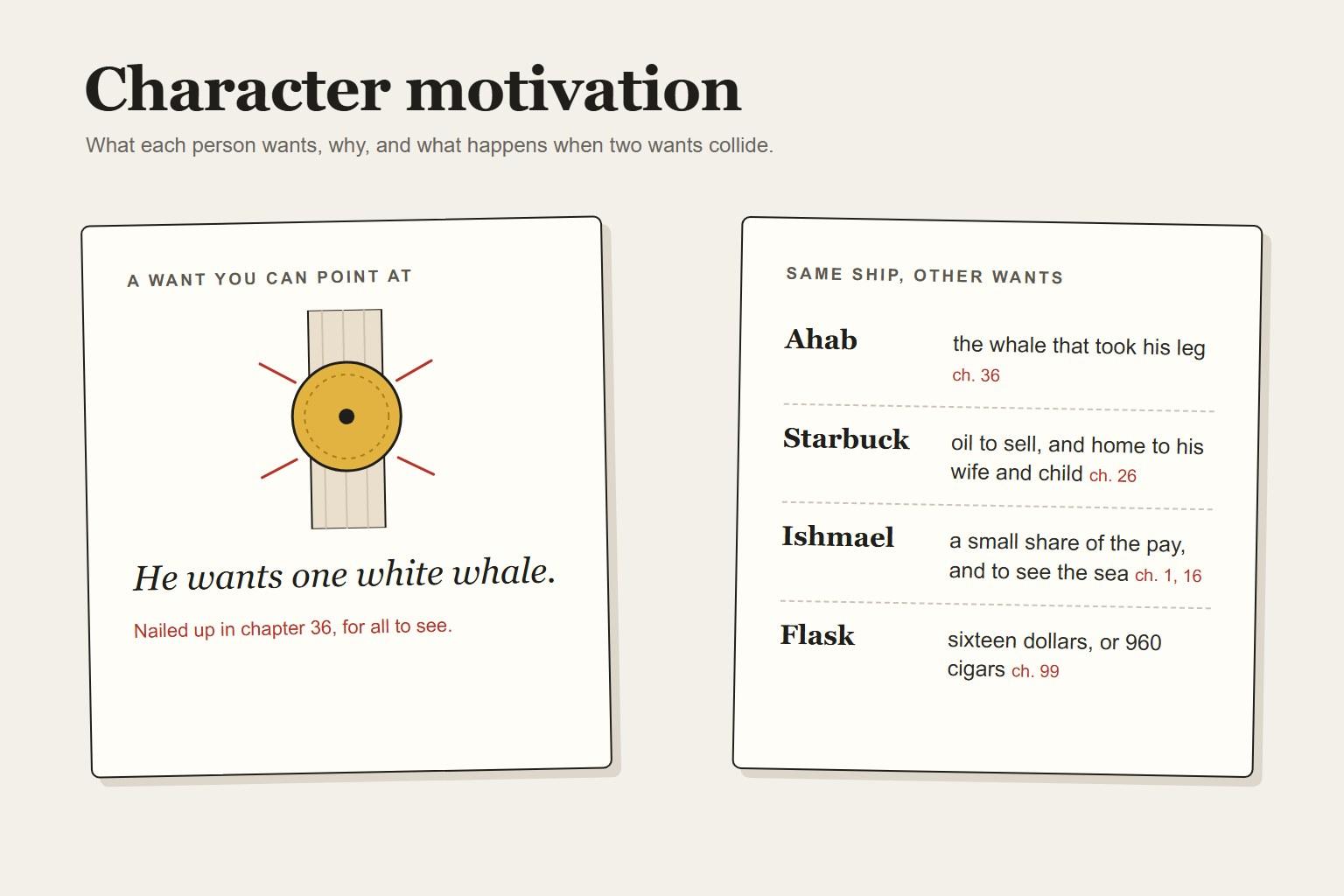
Ahab wants one whale dead, because that whale took his leg. You could write that on a card and leave it there. Melville hammers it to a mast instead, as a coin the crew walk past every day. Some sixty chapters later, in chapter 99, the men come up one at a time to stare at it, and each of them sees something else. Flask, the third mate, sees money. "It is worth sixteen dollars, that's true," he says, and works out that this comes to nine hundred and sixty cigars.
When you plan a character, it helps to say what they want as a thing a camera could film. "She wants respect" is hard to put in a scene. "She wants her name painted on the door of her father's shop" can be painted, scraped off and fought over. If all you have is the abstract version, ask what your character would point to if somebody said, show me. Then get that object or place into an early chapter, so the reader has seen it before it starts to matter.
It is worth checking that the want asks your character to do something. A wish to be left alone gives her nothing to go after. You can often turn it round by asking what she would have to get, or get rid of, before anyone would leave her alone, and making that the want. Look at when the reader learns it, too. If it first shows up on page 80, the pages before it can feel like waiting. We would try to have her act on it, even in a small way, inside the first chapter or two.
The reason under the reason
Starbuck thinks the case is simple. A whale bit a man, and the whale is "a dumb brute" that "simply smote thee from blindest instinct." Ahab tells him there is "a little lower layer." To Ahab the whale is a wall he is shut behind: "How can the prisoner reach outside except by thrusting through the wall?" We don't claim to follow every line of that speech. What we can see is that Melville has given Ahab a want, which is the whale, a reason, which is the leg, and a second reason below that one. He can't bear that something hurt him and meant nothing by it.
For the main people in your book, try asking why twice. Why does she want the shop? It was her father's. Why does that matter so much? He left it to her brother. The second answer is the one we would lean on, because it tells you which offers she would turn down. Starbuck tries to talk Ahab round with barrels and market prices, and it fails because money was never the point. You may never state the second reason in the book. It still earns its keep, because it is how you know what your character will do when the easy way out is offered.
A mistake we see a lot is the motive handed over as history, in a block, before the reader has any cause to care. Melville goes the other way. Ahab shouts the bare fact in chapter 36, "it was Moby Dick that dismasted me," and the full account of the fight waits until chapter 41. By then we have watched him nail up the coin and we want to know. Showing the want first and the history second is not a law, but it is a safe order to try if your opening chapters feel slow.
A manuscript studio with source-linked Wiki review.
Everybody else on the ship
Ishmael, who tells the story, goes to sea "having little or no money in my purse, and nothing particular to interest me on shore." He is broke and bored. In chapter 16 he signs on for the three hundredth lay, a small share of whatever the ship earns. Starbuck has a "young Cape wife and child" waiting at home, as chapter 26 tells us. And Ahab knows all of it. In chapter 46 he reasons that a crew won't chase one whale for nothing: "I will not strip these men, thought Ahab, of all hopes of cash." So he keeps hunting ordinary whales on the way.
We like that chapter because Ahab is doing a writer's job in it. He goes through his crew, asks what each man is there for, and works out how long it will hold.
You can do the same on one page. List your cast, and beside each name write what that person wants and what they would do to get it. Then look for the places where two wants run into each other. Two people who want the same thing for different reasons can carry a scene, and so can two who want different things from one event. A side character who wants nothing tends to stand about agreeing with people. The want can be small, like getting paid or getting home before the snow.
When we make this list for a draft, there are often two or three people whose line just says "helps the hero." That is a job in the plot, and it isn't a want. For each of them, ask what they would be doing this week if the hero had never turned up, and write that down. Sometimes the answer gives you a new scene, because the helper turns out to have somewhere else to be.
Wants also shift, and over a long draft that is easy to lose. A mate who wanted to turn for home in chapter 5 shouldn't be cheering the chase in chapter 20 unless the reader saw what changed his mind. (We make AxiomStory, and its Wiki keeps a page for each character as you write, which is one place to note what each of them wants and where that changed.) A character bible on paper does the same job, and our piece on character flaws covers the fault that often sits right beside the want.
When two wants can't both win
Near the end, in chapter 123, Starbuck stands outside Ahab's cabin holding a loaded musket. The captain is asleep on the other side of the door. Starbuck believes the old man will drown them all, and he thinks of home: "A touch, and Starbuck may survive to hug his wife and child again." He also can't make himself shoot a sleeping man. He puts the musket back in its rack and goes up on deck.
That is a motive under test. Starbuck wants to get home, and he wants to stay the kind of man he is, and for one page he can't have both. If you can find the scene in your own draft where your main character's two strongest wants pull apart, you probably have one of your best scenes. If there isn't one, the motive may be going through the whole book without ever being pushed.
Ahab gets a moment a little like it in chapter 132, when he looks at Starbuck and talks about his own wife and child at home. It passes. In chapter 133 the white whale is sighted at last. Ahab cries out first. Tashtego, one of the harpooneers, says he saw it at the same instant, and Ahab won't have it: "the doubloon is mine, Fate reserved the doubloon for me."