A character flaw is a fault in how a person thinks or behaves that causes them trouble in the story. Jane Austen's Pride and Prejudice has two of the best known, and they are in the title. What we like about the book is that Austen doesn't leave them as labels. She has her two leads argue about their flaws out loud, early on, when neither of them knows how much trouble is coming.
It happens in chapter 11, in the drawing room at Netherfield, when Elizabeth is teasing Darcy about whether he has any faults at all. He answers quite seriously. "My temper I dare not vouch for," he says, and then, "My good opinion once lost is lost for ever." Elizabeth agrees that this is a real failing and tells him, "your defect is a propensity to hate everybody." He smiles and says hers "is wilfully to misunderstand them." Each of them is about half right.
A flaw that causes something
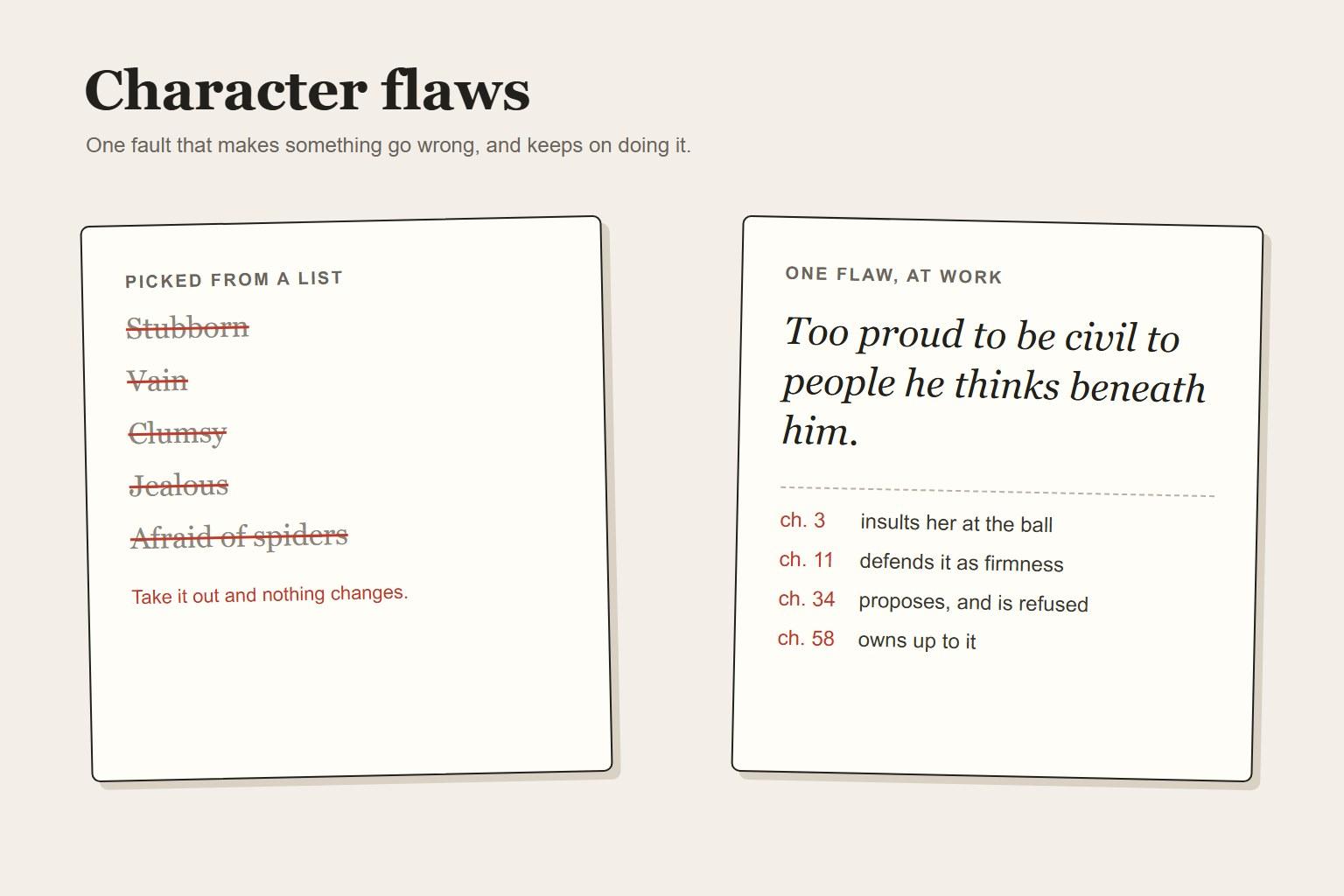
Lists of character flaws are easy to find, and some run past a hundred: stubborn, vain, clumsy, jealous. A list can start you off. The trouble is that it treats a flaw like eye colour, as a thing you pick and write on the sheet. In Austen's book the flaws make things happen. In chapter 3 Darcy looks at Elizabeth across a ballroom and says, where she can hear him, "She is tolerable: but not handsome enough to tempt me." That is his pride talking, and it is a large part of why she is ready to believe the worst of him when Wickham turns up with a sad story. Her quick judgment then keeps her wrong about both men until chapter 36.
So when you choose a flaw for someone in your book, we would ask what goes wrong in the plot because of it. It can be easier to work backwards. Take the worst decision your character makes in the story and ask what sort of person would make it. If you can take the flaw out and every scene still happens the same way, it is probably decoration. A fear of spiders is like that in a lot of novels. It may be worth swapping for something that makes your character do a thing they will be sorry for later, the way Darcy says his line at the ball.
It also helps when the flaw sits close to something good in the person. Elizabeth misjudges people because she is quick and funny and often right about them, and she has come to trust that. Darcy's pride is hard to pull apart from his loyalty to his friends and his sister. Mary Bennet, of all people, draws a useful line in chapter 5: "Pride relates more to our opinion of ourselves; vanity to what we would have others think of us." If you can say which good habit your character's flaw is the bad side of, the same habit can help them in one chapter and sink them in the next. One way to find it is to write the flaw and the strength as a single line, such as "she trusts her first read of people." Then look for a scene in your draft where that helps her and a scene where it hurts.
Who gets to say it
In an early draft the narrator often announces the flaw. Tom was arrogant. Austen's narrator does a little of this herself, and tells us in chapter 3 that the whole room has decided Darcy is proud. But the scenes we remember are the ones where somebody says it to his face. When Darcy first proposes, in chapter 34, he tells Elizabeth how hard he has fought against loving her, and the narrator notes that he talks about her family being beneath him as warmly as he talks about love. She turns him down. He is, she says, "the last man in the world whom I could ever be prevailed on to marry." The proposal is his pride in action, the refusal names it, and Austen adds very little comment of her own.
If there is a sentence in your draft where you tell the reader about the flaw, see whether another character could say it, in anger, or as a joke that lands too hard. We also like that Darcy defends himself. In that chapter 11 talk he half presents his grudges as a kind of firmness, which is what most of us do with our own faults.
Some books then give the character a moment of seeing it. Elizabeth reads Darcy's letter and says, in chapter 36, "Till this moment, I never knew myself." She is exact about what was wrong, too: "vanity, not love, has been my folly." Darcy doesn't say his part aloud until chapter 58, when he tells her he was "spoiled by my parents" and allowed "to think meanly of all the rest of the world." Not every story needs this scene, and in a tragedy the character may never get there. Where it does come, it tends to work only if the reader has watched the flaw do damage first, which is one more reason to check the earlier chapters. If you plan a scene like this, count the scenes before it where the flaw costs your character something. We would want two or three, each a little worse than the last.
A manuscript studio with source-linked Wiki review.
Keeping the flaw in the book
A thing that goes wrong in long drafts is that the flaw is strong at the start and then fades. Say your proud man is rude at a party in your third chapter. By your twelfth he is pleasant to everyone with no reason given, often because you have grown fond of him. Austen doesn't let Darcy off like that. Halfway through the novel he is still stiff, and the proposal in chapter 34 is as proud as anything he says in the book.
One plain check is to keep a line for each main character with the flaw, the chapter where it first shows, and each later chapter where it costs them something. A long gap is worth a look. The flaw may have gone missing, or the plot may have stopped testing it, or the character may simply be off the page, as Darcy is for chapters at a time. (AxiomStory, the app we make, keeps a wiki page for each character, and that is one place to put the line.) A character bible is the longer form of the same note.
Minor characters are a different case. Mr. Collins is pompous from his first letter to his last, and in the final chapter Austen tells us Mrs. Bennet "still was occasionally nervous and invariably silly." One fixed flaw each seems to be enough for them. For your own side characters, a single fault that shows whenever they appear is usually plenty, and it helps readers tell them apart.