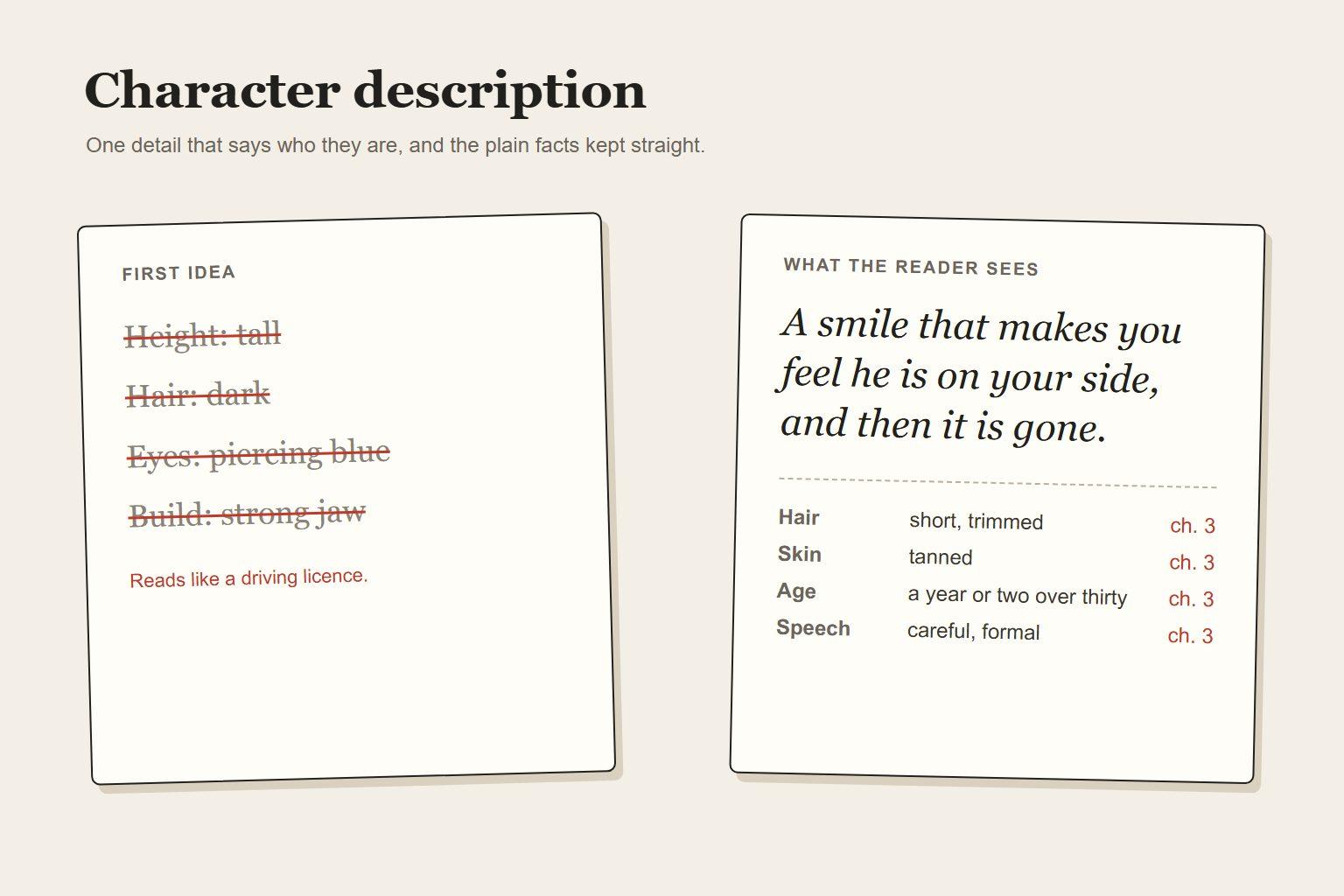
A character description is the handful of words that lets a reader see a person in your story. F. Scott Fitzgerald's The Great Gatsby is a good book to study for it, mostly because he uses so few. When Nick Carraway finally meets Gatsby at the party in chapter 3, we aren't told the colour of his eyes or his hair. We are told about his smile.
"It was one of those rare smiles with a quality of eternal reassurance in it, that you may come across four or five times in life." Fitzgerald stays on that smile for most of a paragraph. Then it vanishes, and Nick is looking at "an elegant young roughneck, a year or two over thirty." A little later we learn that his skin is tanned and his short hair looks as though it were trimmed every day. That is nearly all the book gives us, and it has carried Gatsby for about a hundred years.
One detail that says who they are
The smile isn't there to help us pick Gatsby out of a crowd. It shows what he does to people, which is the thing Nick needs to explain. Tom Buchanan, back in chapter 1, gets more of a body: "a sturdy straw-haired man of thirty, with a rather hard mouth and a supercilious manner," with "two shining arrogant eyes" and what Nick calls "a cruel body." Fitzgerald chose the mouth, the eyes and the build, and all of them say bully. By the end of chapter 2 Tom has broken a woman's nose with his open hand, and it isn't a surprise.
So before you describe someone, write one line for yourself about what the reader should think of this person the first time they meet. Then pick one or two features that carry it. Height, hair, eyes and build, in that order, is what most of us write first. It reads like a driving licence, and it says very little about who the person is.
The first detail that comes to mind, the piercing blue eyes or the strong jaw, tends to be the first one that comes to everybody. We have seen a machine do the same thing with names. We make AxiomStory, and when we read back six stories our own story model had written, a character was called Mara in five of them. A person describing a face late at night is not so different. It can help to write the first idea down, cross it out, and see what the second and third are. Or take a character you have already described and cut the lines back to the one detail you would keep if you were only allowed one. Then read the scene again with just that in it.
Who is doing the looking
Everything we know about how these people look comes through Nick, and he is not neutral. "Cruel" is his word for Tom's body. In chapter 7 he is trying to say what it is about Daisy's voice, and Gatsby says it for him: "Her voice is full of money." That one line describes Daisy, and it also tells you a good deal about the man who said it.
You can use this in any book with a viewpoint character. Ask what this person would notice. A tailor sees the cut of a coat before the face above it. Someone who is afraid of your villain will see his hands. If two characters would describe a third in the same words, there is a fair chance the words are yours and not theirs.
Timing matters as well. Gatsby's smile arrives in the middle of a conversation, just after he has said, "I'm afraid I'm not a very good host." It is part of what is happening. The weakest spot for a description is usually a pause made for it. The mirror scene is the best known kind, where a narrator looks in the glass and lists what she sees. If you have one, try giving the same details to another character to notice, or put them in an action. A tall woman can duck under a door frame, and then you don't have to say she is tall.
You don't have to do it all at once, either. Gatsby's tan and his haircut come a page or two after the smile. One line when we first meet someone, then a new detail in a later scene, is usually easier to take in than a full paragraph up front.
A manuscript studio with source-linked Wiki review.
The plain facts still have to agree
The trouble with giving few details is that each one gets remembered. In chapter 7 Daisy holds up her small daughter, whose hair she has just called "yellowy," and says, "She's got my hair and shape of the face." In chapter 8 Gatsby remembers the last afternoon before he went abroad, when he kissed Daisy's "dark shining hair." You can read the novel closely and still not be sure what colour her hair is.
We don't know if Fitzgerald meant anything by that or just lost track, and it has not hurt the book. In your own draft it would be one of the small continuity errors that a reader writes to you about.
The fix is dull. Keep one line for each character with hair, eyes, any scars or marks, and height next to someone else in the cast. Beside each fact, put the chapter where it first shows up. A character bible is the longer form of the same idea. When the draft is finished, search it for hair, eyes and each character's name, and read the hits in order. AxiomStory's Wiki does a version of that search for us, and it doesn't catch everything the first time. Whichever way you do it, do it again after any big revision, because moving scenes around is when the left hand turns into the right.