When we built a Wiki of The Count of Monte Cristo in AxiomStory, the part that gave us trouble was names. Fernand Mondego spends half the book as the Count of Morcerf. Benedetto shows up in Paris as Andrea Cavalcanti. Dantès himself is a sailor, an abbé, an English lord and a count. Our first build gave some of these people two pages, and we are still tidying that up.
Dumas meant every one of those names. When a writer doesn't mean it, it's a continuity error: a fact in a story that changes when nothing in the story says it should. Gray eyes in chapter 3 and brown ones in chapter 19. A ride that takes three days in one scene and an afternoon in another. Most long first drafts have a few, and some get all the way into print.
Some famous continuity errors in books
Robinson Crusoe takes off his clothes to swim out to the wreck, and once he is on board he fills his pockets with biscuits. Readers have been poking fun at that one for about three hundred years.
Dr Watson's war wound is in his shoulder in A Study in Scarlet and in his leg in The Sign of Four, the next Holmes novel. In a later story, The Man with the Twisted Lip, his wife calls him James, though his name is John. Dorothy L. Sayers once argued that his middle name was Hamish, which is Scottish for James. (Wikipedia's page on Watson has the details.)
In Don Quixote a thief steals Sancho Panza's donkey, and a few chapters later Sancho is riding it again. A second printing that same year patched it, not very neatly. In part two, ten years later, the characters joke about it and Sancho finally tells how the donkey was stolen. (Here is that chapter of part two.)
The first printing of Harry Potter and the Goblet of Fire has a slip near the end. When the wands connect, the people Voldemort killed come back out of his wand newest first. He killed James before Lily, so Lily should come out first. In the first printing, James did. Fans caught it within about two weeks, and Salon covered it. Later printings swapped them.
Do readers actually care?
Some do and some don't, and it depends a lot on what slipped. Holmes fans turned Watson's wandering wound into a game they have been playing for a century. Nobody stopped reading Crusoe over the biscuits. But a reader who has followed a romance series for three books is much more likely to notice if the hero's scar from book one quietly disappears, and some of the reader forum threads about this kind of thing are not friendly.
Our rough rule, and it is only a rule of thumb, is that readers let more slide in details the story doesn't lean on. A coat that changes color mid scene will bother some readers and slip past most. A secret one character could not possibly know yet is a different matter, because readers have been tracking who knows what the whole time. So if you only have time to check one thing, check the facts your plot depends on.
Most continuity errors come from the same short list: how people look, wounds that heal too fast, dates and ages, travel times, who is holding what, and names. Monte Cristo taught us that names are worse than they look. Minor characters get renamed by accident because you only typed the name once, and major ones pick up titles and nicknames until it is hard to tell whether two lines are about the same person. Knowledge slips, where a character acts on something nobody has told them yet, are the hardest of all to see because the sentence itself looks fine.
Under all of them is time. You might write chapter 3 in March and chapter 19 in August, and change your mind about a character in between. The version in your head is the new one. The page still has the old one. Revising adds more. Move a scene earlier and someone may mention a fight that has not happened yet. Cut a chapter and the only place a minor character got his name may go with it.
A manuscript studio with source-linked Wiki review.
How to catch continuity errors
A single read at the end is the hard way, because by then the book is too long to keep in your head. Small habits along the way do more.
Keep a continuity log. When you write a fact that might come up again, like a scar, a birthday or the name of an inn, note the chapter and the exact words. Copy editors call this a style sheet, and most of them keep one for each book they edit. Give every character one line with all the names they go by, titles included. A notes file is enough, and we have a free continuity log template if you want a starting point.
Keep a timeline by day, not by chapter. Write down which day each scene happens on. A lot of time slips show up as soon as you count.
When you reread, look for one kind of thing per pass, such as how people look, or who knows what. Search helps too. Look up each character's name, and each of their other names, and read every hit in order. Then search for eyes, hair, scar and limp.
Then give the draft to someone else. A friend will often notice that a water skin was empty in chapter 7 and full in chapter 8. You might not, since you refilled it in your head.
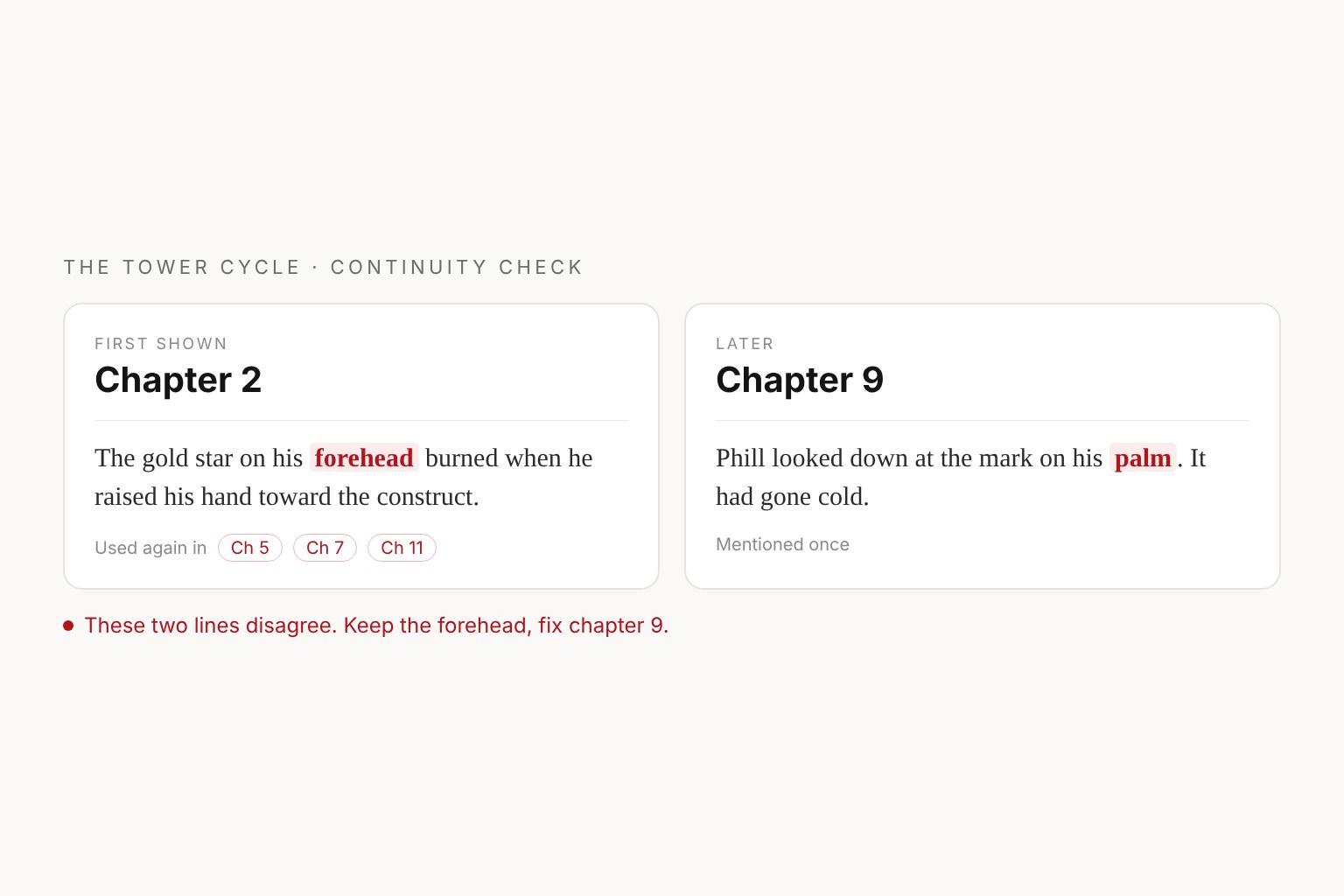
When you find one, keep the version the rest of the book depends on and fix the other. If the scar is on the left cheek in five scenes and the right in one, change the one. It gets harder when the plot needs the change. Say your climbers manage about one floor of a tower a day, and in chapter 10 you need them to climb five before dinner. You can give them an old lift shaft, but then nine chapters of stair climbing look a bit silly. There isn't always a clean answer, and sometimes the honest choice is to rewrite the chase.
Some breaks are on purpose, like a guard who greets the hero by name when nobody told him, or a count who used to be a sailor. Mark those as deliberate in your log, so an editor (or you, six months later) doesn't fix them.
One last note, since this is our blog. AxiomStory, the app we build, keeps a log like this for you. Its Wiki reads your chapters and gives each character, place and object a page, with every fact linked to the chapter it came from, and it points out lines in different chapters that seem to disagree. As the Monte Cristo build showed us, it won't get everything right the first time, so a second reader is still worth having. It is free to try, and for a series it sits alongside the rest of your story bible.