Character backstory is everything that happened to a character before the first page of your story. Most of it belongs in your notes. The part that does reach the reader tends to work best when it comes late, and when somebody in the story needs to hear it.
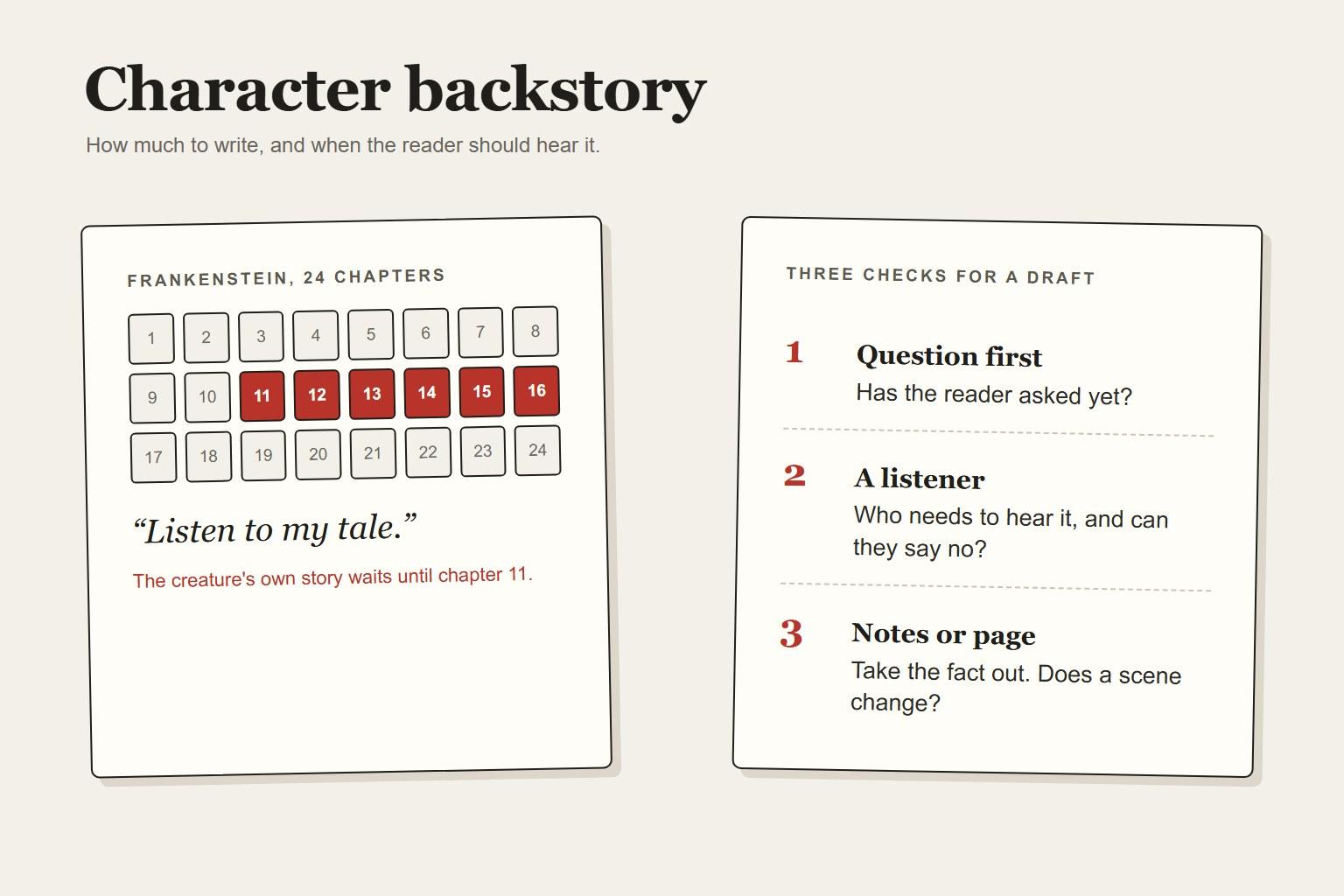
Mary Shelley's Frankenstein, first published in 1818, holds back its most important backstory for half the book. In chapter 5 the creature opens one "dull yellow eye" and Victor Frankenstein runs from the room. Then we lose sight of the creature. A child is murdered and a servant girl is put to death for it, and all of this comes to us through Victor, who is sure the thing he made is a monster. In chapter 10 the two of them meet on a glacier above Chamonix, and the creature asks for one thing: "Listen to my tale."
Let the question come first
He gets six chapters, 11 to 16, and by then the reader has been waiting for them. Where has he been? How did he learn to talk? He says he hid in a hovel that joined a cottage, watched the family through a chink in the wall and picked up their language by listening. He found a leather bag in the woods with some clothes and books in it. Later he read the papers in the pocket of the clothes he had taken from the laboratory, and they turned out to be Victor's own journal of the four months before he was made.
So when you want to put backstory into a chapter, it is worth asking whether the reader has a question yet. Say your sheriff won't carry a gun. If nobody has noticed, two pages about the day he gave it up will read as a delay. Let him turn the gun down twice, and let it cost him something the second time. After that the same two pages are an answer, and people will read an answer quite happily.
You can check a draft for this in an hour. Go through your first three chapters and mark each passage that tells us about the past. Beside each one, write the question it answers and the page where a reader would first ask it. If the answer sits on page 4 and the question doesn't come up until page 60, move the passage or cut it down to a line. We find most early backstory can shrink to one sentence, with the rest saved for later.
Shelley is not strict about this herself. Victor's own history starts at the top of chapter 1 with "I am by birth a Genevese," and it runs on through his parents and his schooling for a good while. We think those chapters are the slowest in the book. They get by because the letters before them have already shown us Victor pulled off the sea ice, "nearly frozen," chasing something north. We want to know what he is chasing, and that is enough to carry us through his childhood.
Somebody has to be listening
The creature is not telling his story to us. He is telling it to Victor, and he wants something for it. "I was benevolent and good; misery made me a fiend," he says before he starts, and when he has finished he names his price: "You must create a female for me."
That makes six chapters of backstory into an argument. He chooses what to put in. He lingers on the cottage family, on how he gathered wood for them in secret and on how they drove him out. He is honest about the murder too, but he tells it as a man making a case.
When a character's past has to be told at length, we would look for the person in the book who most needs to hear it and who is able to say no. Then ask what the teller wants from them. A mother explaining to her daughter why they left the old country is doing something in the scene. She may be asking to be forgiven, or warning her off a boy. The same facts in three paragraphs of narration can work as well, but there they have only the voice to carry them. Dialogue has its own trap, which is two people telling each other things they both know. If the listener has heard it all before, a different listener is usually the easier fix.
A told story can also be slanted, and that is a second use for it. Your character may leave things out or make herself look better. You don't have to settle on the page how much is true, but you should know.
A manuscript studio with source-linked Wiki review.
More in the notes than on the page
It helps to know more than you tell. Our rough rule is a page of history for each main character and a few lines for the smaller ones, written before the draft or early in it. Then be hard on what goes into the book. The test we like is to take a fact out and see if any scene in the present changes. The creature's reading of Paradise Lost stays in, because it is why he calls himself a fallen angel when he talks to Victor. If he had found the book and never thought of it again, it would be notes.
Past events also have to agree with each other, and that gets harder over a long draft. A brother who died when your hero was nine in chapter 2 can't have taught him to drive in chapter 30. A dated list for each main character, with their age beside each event, catches most of this. (We make AxiomStory, and its Wiki builds a page for each character from your chapters, which is one place to keep that list.) A character bible on paper does the same job, and our piece on character motivation covers what a character wants now, which is often where the backstory ends up pointing.
Victor's answer comes in chapter 17. "His words had a strange effect upon me. I compassionated him," he says, and a few pages on he agrees to build the companion: "I consent to your demand."