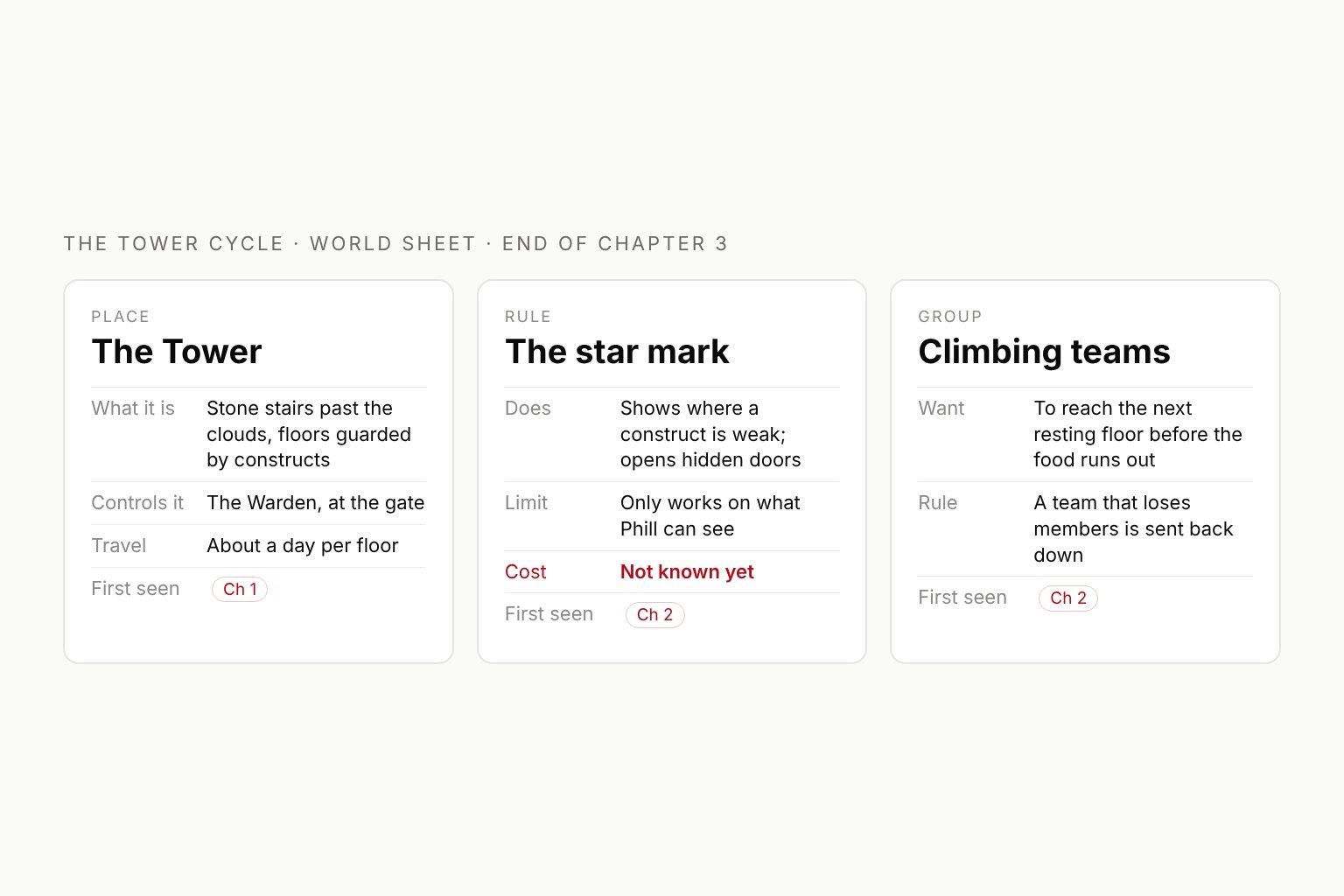
A worldbuilding template is a set of headings and questions you fill in to describe your story's world, kept in one place so you can check it while you write. The best test of one is whether it protects the facts a reader would notice if you broke them. Tolkien's map is a good place to see why.
Facts that must stay put
In a 1954 letter to Naomi Mitchison, Tolkien wrote: "I wisely started with a map, and made the story fit (generally with meticulous care for distances)." His main map was drawn on squared paper, with each 2 cm square standing for 100 miles. A scale means every walk in the book has a length, and a length means a number of days.
You don't need a good map. You need the habit behind it: when a character goes from one place to the next, the trip takes a set amount of time, and that time doesn't bend to suit the plot. Say your hero rides three days to reach the capital in chapter 4. If she is back there in an afternoon in chapter 20 because the plot needs her, a careful reader will feel the floor shift.
So write the travel time down the first time you invent it, and write down the chapter. When the plot later wants a faster trip, give the characters a reason, such as a better road or a fast horse that costs something, or change the plot.
A rule needs a limit and a price
The Ring in The Lord of the Rings makes its wearer invisible, and it has kept Bilbo from aging. The cost shows up in the novel itself, before Bilbo's 111th birthday party, when he tells Gandalf: "I feel all thin, sort of stretched, if you know what I mean: like butter that has been scraped over too much bread."
Bilbo says it in his own words, and the reader believes it. When you fill in a rule, you are really collecting what a character could say about it on a bad day.
For any magic or technology, you need to know what it does, where it stops, what it costs the user, and who can use it. Then ask what would go wrong if everyone could use it. If the answer is "nothing," the rule is probably too weak to matter or too strong to be fair to your villain.
A manuscript studio with source-linked Wiki review.
What goes in the template
Many templates online are long lists of a hundred questions or more. This one is shorter and starts from your scenes. Every entry has two small fields: the chapter where readers first see it, and the scene it changes. If you can't fill in the second one, the entry may not belong yet.
It opens with a pitch, which is the world in one sentence plus what makes it different from other worlds in your genre. Places come next. For each, you note how it looks and sounds, who controls it, and how long it takes to travel to the next place in the story. Power covers who is in charge, how they keep it, who wants it, and what happens to rule breakers. Ask who can say no to your main character, and why people obey.
Groups and belief cover families, guilds, faiths and crews, and for each you write what it wants, what it fears and what it takes for granted. The last of those tends to give you the best scenes. Daily life covers money, food, work, travel and how news moves. Ask what a meal costs and who goes hungry.
History comes in only as history that still matters: the old war, flood or betrayal that people still argue about or suffer from. And the template ends with open questions, so that nothing gets decided by accident.
Our Wiki writes a page for each character, place and group in a book, and it made this very mistake. Small parts of a page, like one called "Reading the mark," were getting a full heading the same size as the big sections, because topics we required on every page were being added as top-level sections and leaving thin ones at the end. Now each required topic joins a parent section. Do the same in your template: a small fact like how a mark is read belongs under a broader heading such as rules, not on a line of its own.
An order that keeps you writing
Most writers don't need to build much before chapter one. Tolkien told his American publisher in a 1955 letter that "the invention of languages is the foundation," and said the stories were made to give the languages a world, rather than the other way round. The Return of the King then ends with long appendices: a chronology of the ages, family trees, calendars, and notes on languages and writing. Unless your book is built around a language, it is not a model for your first month.
Patricia C. Wrede's widely shared list of fantasy worldbuilding questions, posted on the SFWA site, says plainly: "It is not necessary for an author to answer all, or even any, of the questions in order to start writing," and adds, "(or to finish writing, either)." Writers call it worldbuilder's disease when someone spends years building a world and never writes chapter one.
Our rough rule is to fill in the pitch first. Then add only the places and groups your first chapters use. Write every rule with its limit and cost as soon as the rule appears. Do power next. Fill in daily life only for places your characters live in or pass through. Leave history for last, and include only what someone in the story cares about.
After each writing session, add any new fact you invented, with its chapter. A river you mentioned in passing is now a fact, and in chapter 30 you will not remember its name.
What a filled template shows you
A rule with no limit or cost means the hero can solve anything. Travel times that shift to suit the plot show up as two different numbers for one road. One culture per country usually means you stopped thinking at the border. A ruler everyone obeys for no reason anyone in the story knows is a ruler the reader won't believe. History that never touches a character's choices is decoration.
The hardest one to see is timing. Say the reader learns in chapter 18 that the Ring-like object can be destroyed with a certain tool, but your villain had that tool in chapter 9. The rule is fine. Its place in the book is wrong. Either the reader learns it sooner, or the villain has a reason he couldn't use it. Because every entry carries the chapter where readers first see it, you can read down that field and catch a rule that arrives too late.
It won't catch everything. A template can't tell you whether a scene is any good. It only keeps your facts in one place, so you can see when they disagree.
The template is free as a plain text file that opens in Google Docs, Notion, Obsidian or a phone notes app. Copy it once per book, or once per region if your world is large. It sits inside a larger story bible, and this blog has a separate guide on that.
To try it today, open the chapter you are working on and pick one trip a character makes. Write down the places, the time it took, and the chapter number. Then search your draft for any other mention of that trip and see whether the numbers match.