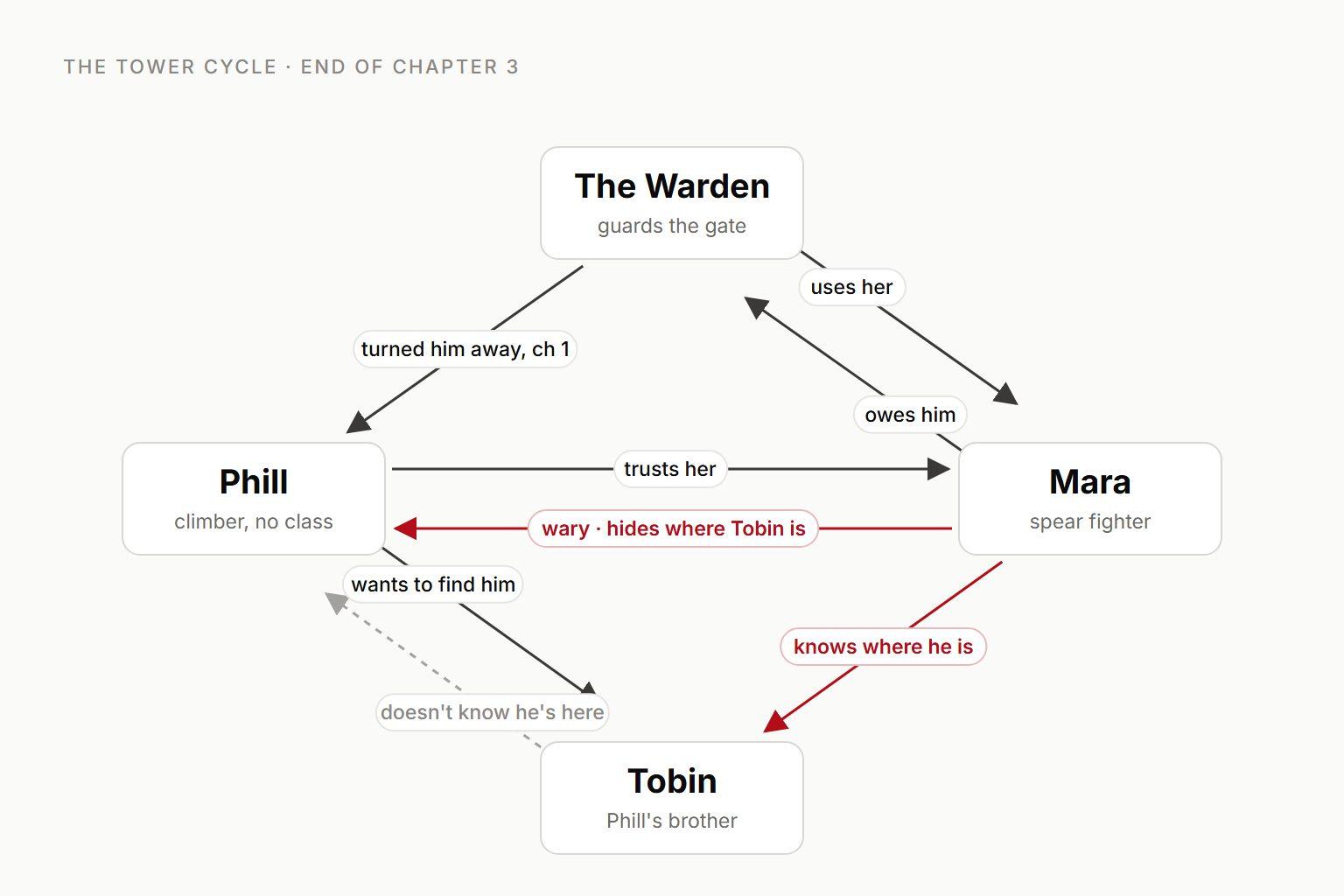
A character relationship chart is a page of names in boxes or circles, with lines and short labels showing how the people in a story are tied to each other. In George R. R. Martin’s A Game of Thrones, Joffrey’s place in the royal family is not enough to explain the danger around him. He is publicly King Robert’s son and heir, but his father is Jaime Lannister, his mother Cersei’s twin brother.
A family tree could show either biological parentage or the publicly claimed line, as long as you label which it records. The trouble is not the tree. It is asking a record of kinship to carry Ned Stark’s discovery of the secret, along with what he plans to do about it.
That is the part worth mapping for your own book. Keep the family tree if you need one, but give knowledge and trust room of their own.
A line needs something that happened
“Friend” is a useful label until you need to write a scene. It says little about what one person wants from the other, or what might stop them from asking for it.
An arrow gives you room to be more exact. It runs from the person whose view you are recording toward the person they have that view of. The return arrow gets its own label, because trust need not run both ways.
Here is a small worked map for the point after Ned confronts Cersei, before he can tell Robert:
- Ned → Cersei. Knows Jaime is her children’s father. Has offered her a chance to escape with them. Scene reference: Ned confronts Cersei.
- Cersei → Ned. Knows he has learned the secret. Knows he plans to tell Robert. Scene reference: the same confrontation.
These arrows record a particular state of the tie, not a verdict on either person. “Enemies” would be less useful when working out what each can say in their next scene.
For your draft, add the chapter reference beside each arrow. The scene names here anchor the example without inventing chapter numbers. A tie with no chapter attached belongs among your plans until a scene makes it part of the book.
You do not need to fit a full character profile onto every line. Choose the detail that puts pressure on the scene: a promise still owed, perhaps, or a false belief about the other person. Longer notes can live on the character’s profile, with the name on the map linked to it. The separate guide to the character bible covers that work.
Keep the secret apart from the label
Bran Stark sees Cersei with Jaime while climbing the castle walls. Jaime pushes him out of the window; Bran survives, but is left in a coma and cannot walk. An entry saying only “Bran knows” would miss his state at that point.
There is a difference between witnessing something and being able to act on it. There is also a difference between a secret being true and a character knowing it. Keep those separate in your notes, rather than letting the truth of your planned plot leak into everyone’s choices.
A distinct color can mark the arrows that carry secrets. Beside each, record what that person knows, including anything they have wrong. Your private record can hold the truth, while the arrow holds that character’s view at that chapter.
The free template offered with this page is a plain text file that opens anywhere. It includes a cast list and a row for each direction of a tie. Its “who knows what” table records each secret, who knows it and who must not, with space for the reveal chapter; there is also room for turning-point snapshots and checks.
The reveal chapter needs to belong to the person learning the secret, not just to the secret itself. Ned works out the children’s parentage from an old book of house lineages, then tells Cersei what he knows. Those are separate changes. In your own draft, check the first scene where someone acts on hidden knowledge against the scene where they gained it, especially after moving chapters during revision.
A manuscript studio with source-linked Wiki review.
Give each tie its own space
AxiomStory’s Wiki builder made separate relationship pages with paired names as titles, sometimes with a picture; our founder decided the information belonged on each character’s page, since a pair picture repeated the people’s pictures. We moved ties into a Relationships section with a named part for each person, asking the model for the events that changed each tie and where it stood now. The first live build often gave one general section instead, so we made further fixes.
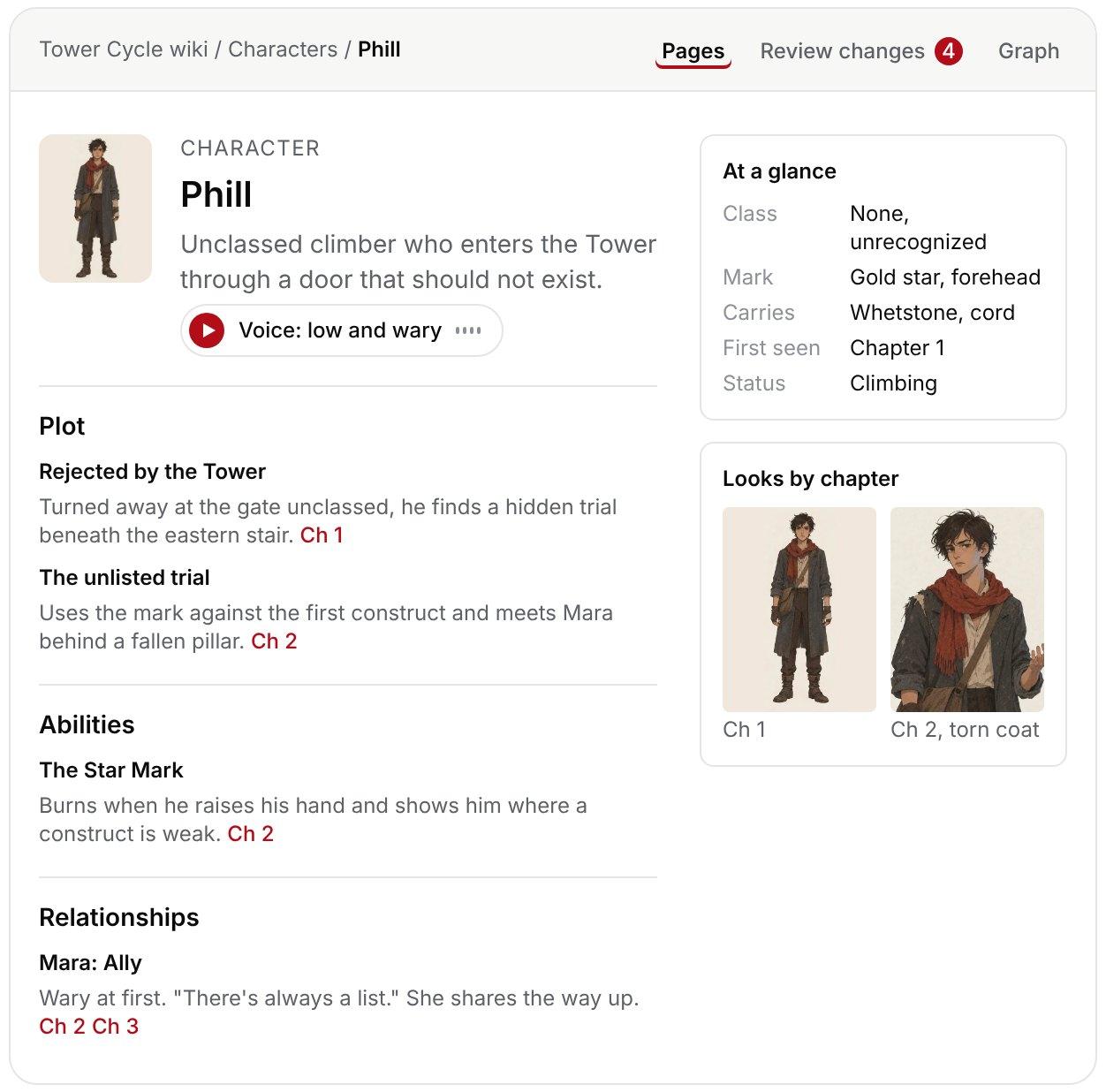
The useful distinction for your notes is between having a section called “Relationships” and actually recording each relationship. A paragraph about how guarded someone is does not tell you whom they trust with a particular secret. Give each important tie its own space, even if its entry is short.
My rough rule is to keep the event beside the label. If someone owes a favor, record what created the debt; if trust breaks, name the scene where it broke. That leaves something concrete to check when a later scene depends on it.
A large cast also needs a shape you can read. Boxes around families or teams can keep names from becoming a loose crowd, while arrows still cross the group borders. A Game of Thrones ends with an appendix listing the Great Houses and their members. That kind of cast reference can sit beside your working map without carrying all its plot notes.
Revise the arrows that moved
A map made before chapter one will need changes as you write. Save a copy at a major turning point, such as the midpoint, rather than writing every later event over the first version. On the new copy, change the arrows affected and add the chapter and cause.
Ned’s appeal to Littlefinger needs that care. He asks for help taking Cersei and Joffrey into custody; Littlefinger betrays him, and Ned is arrested. A later label of “betrayer” must not replace the record of what Ned wanted from him before the betrayal.
When reviewing your own map, look for a main character with no friction in any tie. A person with no lines may need a stake in another character’s choices, or may be worth cutting or merging. If every line uses the same word, return to the scenes and find the difference between those ties.
Check, too, that the ties exist in scenes rather than only in your notes. A planned debt cannot yet support a later demand for repayment. Either give it a scene or revise the demand.
For a small revision pass, choose a scene where trust changes. Save the map as it stood before that scene, then copy it and rewrite the affected arrows, with the chapter beside them. Leave the unchanged ties alone while you work through what each person now knows.