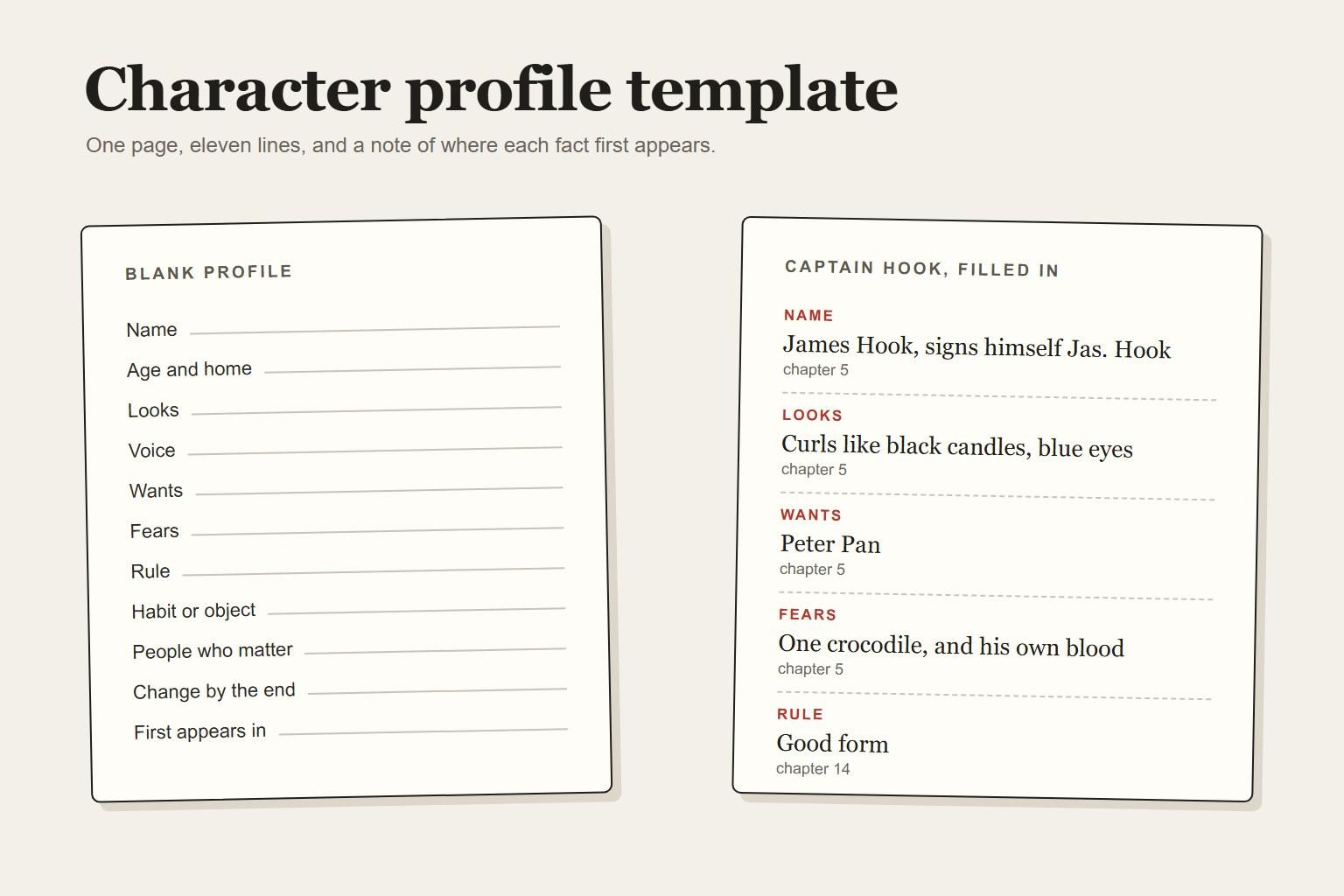
A character profile template is a short set of questions you answer about a character, so that the facts about them stay the same from the first chapter to the last. The one below fits on a page. Copy it, and fill in only the lines your story will use.
The template
- Name, and what other people call them
- Age, and where they come from
- Looks: two or three things a stranger would notice first
- Voice: how they talk, and a word or phrase they overuse
- What they want in this story
- What they are afraid of
- A rule they live by, even when it costs them
- A habit, or an object they keep close
- The people who matter most to them, and why
- How they are different by the last chapter
- Where each fact first appears (chapter or page)
Most templates you can download are much longer than this. Some run to a hundred questions and ask for a favourite food, a star sign and a blood type. We think the long ones do more harm than good for most novels. You spend an evening filling them in, the answers never reach a scene, and the few facts that matter are buried among the ones that don't. A short profile is easier to keep up to date as the draft changes, and an out of date profile is not much use to you.
Captain Hook on one page
To see what a filled in profile looks like, take Captain Hook from J. M. Barrie's Peter and Wendy, the 1911 novel of Peter Pan. Barrie gives him to us in chapter 5 in about a page, and nearly every line of the template has an answer there.
His name is James Hook, "or as he wrote himself, Jas. Hook." In looks he is "cadaverous and blackavized," with long curls that from a distance look "like black candles." His eyes are "of the blue of the forget-me-not" and sad, except when he is using the hook, and then two red spots show in them. In place of a right hand he has the iron hook itself. He talks well, even when he swears, and he is "never more sinister than when he was most polite."
What he wants is plain: Peter Pan, who cut off his arm and threw it to a crocodile. That gives him his fear too. He tells Smee he is afraid "not of crocodiles" but "of that one crocodile," which has followed him ever since. It swallowed a clock, so he can hear it coming. Barrie adds a second fear that is stranger. Hook has great courage, but he can't bear the sight of his own blood, "which was thick and of an unusual colour."
His habit is a holder of his own making that lets him smoke two cigars at once. His rule comes later, in chapter 14. He went to a famous public school, and he still cares about "good form" above everything else. He lies awake asking himself whether he has shown it that day.
Some lines stay empty. We never learn Hook's real name, his age or where he was born, and there is nothing about his parents. Barrie even says that to reveal who he really was "would even at this date set the country in a blaze," and then doesn't. A blank on the page is allowed. If a question on your own profile has no answer by the end of the draft, the story probably didn't need one.
A manuscript studio with source-linked Wiki review.
From the profile to the scene
The reason to write any of this down is that the facts should end up changing what happens. In Hook's last fight, in chapter 15, Peter wounds him in the ribs. At the sight of his own blood the sword falls from Hook's hand. Peter could finish him, and instead he waves at him to pick the sword up. What hurts Hook then is not the wound. He has "a tragic feeling that Peter was showing good form." The fear was set up ten chapters earlier and the rule one chapter earlier, and here they decide how the fight goes.
When your own profile is filled in, go down the page and ask of each line where it will matter. Say your detective is afraid of deep water. If no scene ever puts her near a river, the line is doing nothing, and you can cut it or write the scene. We would try to have the fear and the rule each come up at least twice, the first time early and small and the second time late, when it costs something. Want and fear are also worth checking against each other. Hook's are tied together, since the boy he is hunting is the reason the crocodile hunts him, and a profile where the two have nothing to do with each other often points to a plot with two halves. Looks and voice mostly just need to stay the same from chapter to chapter, and that is what the last line of the template is for.
Few of the templates we have seen ask where each fact first appears, and in a long draft it may be the line you are most glad of. A profile says the eyes are blue. The note beside it says "chapter 5," so when you write brown in chapter 22 you can find the first mention in a minute and choose which to keep. (AxiomStory, which we make, builds a wiki page for each character from your chapters and keeps their face the same in pictures. It only knows what you have written, so the wants and fears you haven't put on the page are still yours to note down.)
You don't need a full page for everyone. For smaller parts we would write a name, one thing a stranger would notice, and what they want from your hero, and fill in more only if the character starts to take up more room. The main characters' pages will change as you go. A profile written before the draft is a guess, and by chapter 10 you often know the person better than the profile does. When the two disagree, it is usually the profile that should give way, so long as the earlier chapters can be made to agree with the new version. Read the page again when the draft is done, too. Any line you never used is a detail you can take out of chapter 1.
Barrie did something like this in public. Hook's school is only hinted at in the novel, but in 1927 Barrie gave a speech at Eton called "Captain Hook at Eton," and filled in the rest.