A lot of worldbuilding systems start with the right ambition and the wrong storage instinct. They collect facts because the universe feels rich, but they do not decide which facts should actively shape drafting, retrieval, continuity review, or generation.
A useful lore graph is not a museum of everything the team has ever named. It is a decision structure. It should hold the entities, rules, relationships, events, and passage evidence that change what the next scene can plausibly say or show.
Store what changes downstream decisions
If a fact never changes a scene choice, a retrieval result, or a continuity check, it may not belong in the first layer of the graph. Decorative detail can still be preserved elsewhere, but the graph should prioritize the information that changes execution.
This is the difference between a storage system and a production system. The graph is most valuable when it helps the room decide faster, not when it proves how much material exists.
Entities alone are not enough
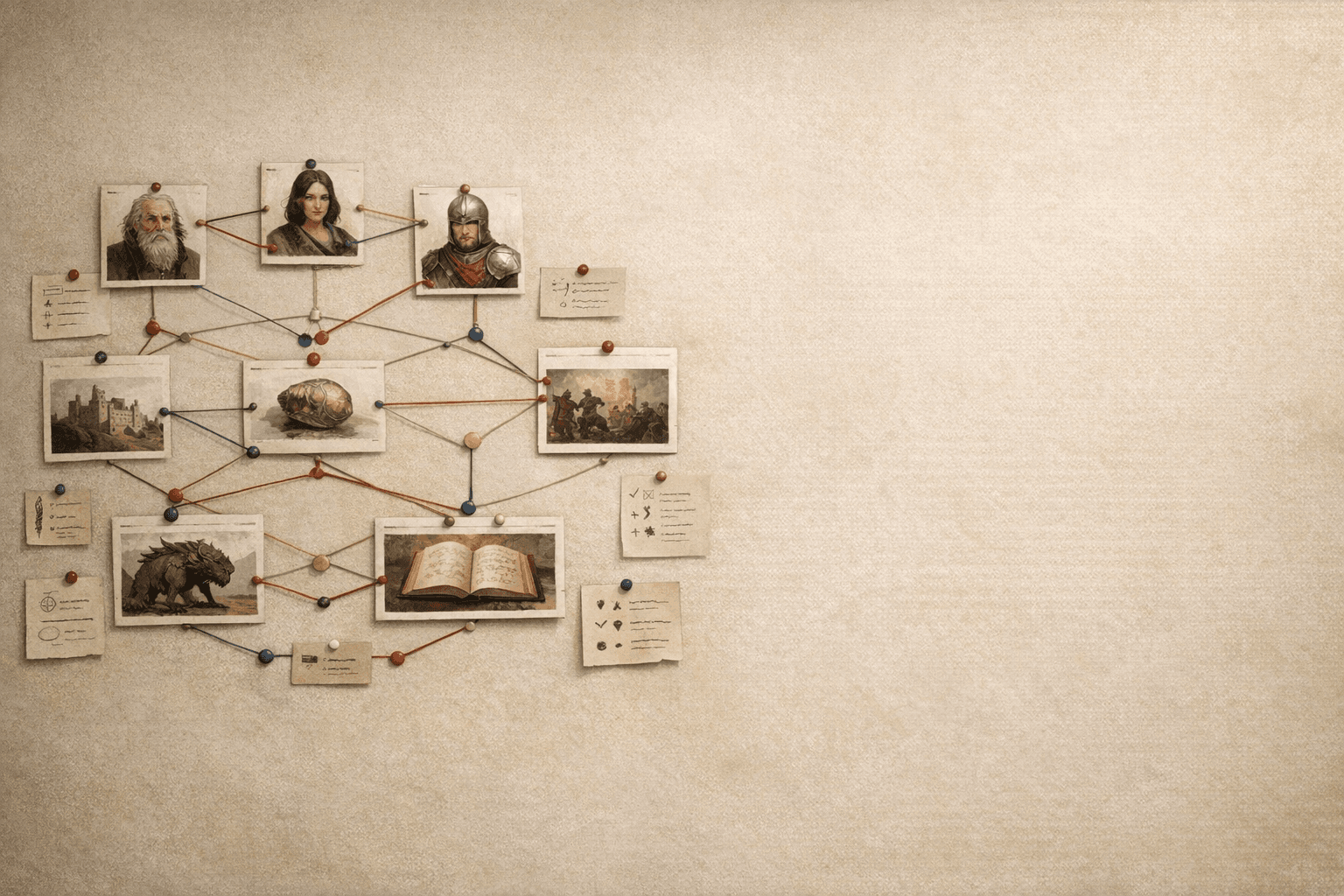
Many lore systems stop at characters, locations, factions, and objects. That is a useful start, but it is not enough to make the graph narratively intelligent. The real value appears when entities are connected by meaningful relationships, constraints, and source passages.
A graph without strong edges becomes an address book. A graph with relationship logic starts to answer story questions instead of merely listing names.
- Relationship edges: loyalty, kinship, ownership, rivalry, command, dependence
- Context edges: scene membership, location relevance, active objective, recent conflict
- Evidence edges: the passages and events that justify why the connection exists
Rules need scope, source, and consequence
Writers often record world rules as plain statements, but the statement alone is not enough. A rule becomes useful when the system knows where it applies, who it affects, and what breaks if the draft violates it.
That means a good lore graph stores a rule with scope and evidence. The room should be able to tell whether the rule is universal, local, historical, disputed, or recently changed by an event.
Events turn summaries into explainable truth
Without events, canon gets overwritten until nobody can explain why the current summary says what it says. A lore graph should preserve the moments that changed the world, because those moments are what make continuity explainable.
Events also help the graph power state. If a city fell, a relic changed hands, or a treaty collapsed, those transitions should live as explicit records instead of disappearing into a rewritten paragraph.
Provenance keeps the graph trustworthy
The fastest way to erode trust in a knowledge system is to fill it with claims that have no visible source. When a graph can cite the scene, draft excerpt, or approved note that introduced a fact, people use it with more confidence and argue with it less.
That provenance matters for model retrieval too. The model performs better when facts are not just asserted, but attached to passage evidence that preserves nuance and wording.